


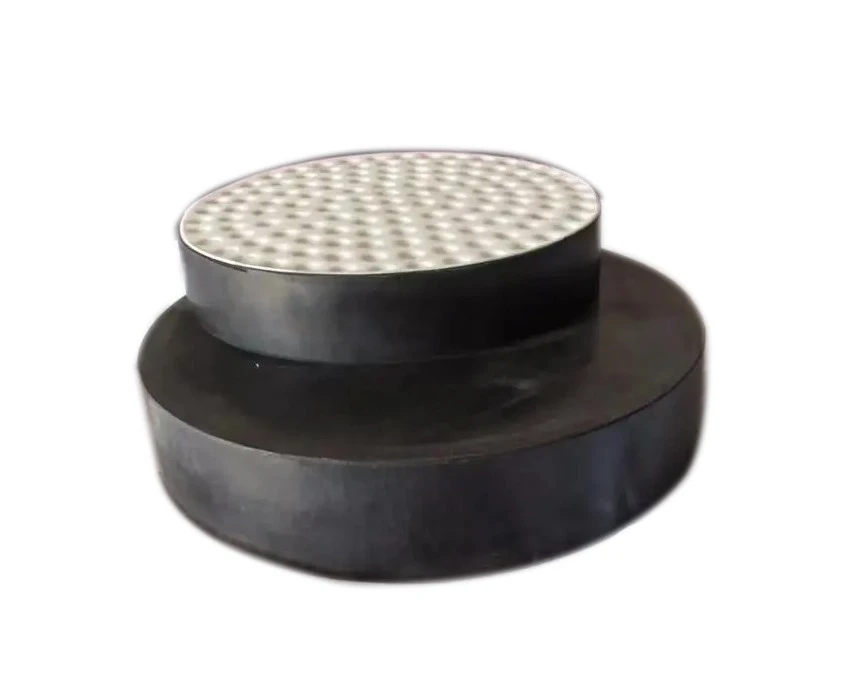


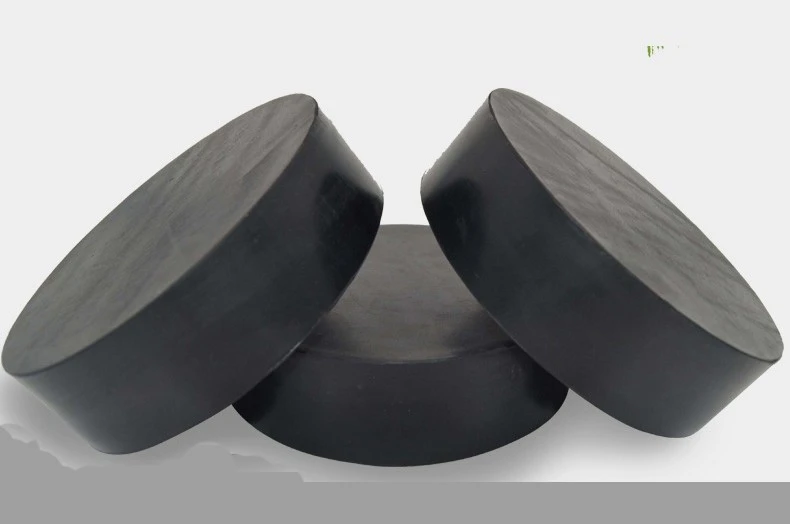

Laminated rubber bearing for highway bridges.
Laminated rubber bearing with PTFE/M-PTFE sheet bonded to elastomer for Road Bridges.

The laminated rubber bearing is formed by vulcanizing and bonding multiple layers of rubber sheets with thin steel plates. It has sufficient vertical stiffness to reliably transfer the reaction force of the superstructure to the piers and abutments. It also has good elasticity to adapt to the rotation of the beam end, and has a relatively large shear deformation capacity to meet the horizontal displacement of the superstructure.

A layer of polytetrafluoroethylene (PTFE) sheet with a thickness of 2mm to 3mm is adhered to the surface of the above-mentioned laminated rubber bearing, and then the laminated rubber bearing with PTFE is manufactured. In addition to having vertical stiffness and elastic deformation, being able to bear vertical loads and adapt to the rotation of the beam end, due to the low friction coefficient of the PTFE plate, the beam end can slide freely on the surface of the PTFE plate, and the horizontal displacement is not restricted. It is especially suitable for the use of bridges with medium and small loads and large displacement amounts.
A layer of polytetrafluoroethylene (PTFE) sheet with a thickness of 2mm to 3mm is adhered to the surface of the above-mentioned laminated rubber bearing, and then the laminated rubber bearing with PTFE is manufactured. In addition to having vertical stiffness and elastic deformation, being able to bear vertical loads and adapt to the rotation of the beam end, due to the low friction coefficient of the PTFE plate, the beam end can slide freely on the surface of the PTFE plate, and the horizontal displacement is not restricted. It is especially suitable for the use of bridges with medium and small loads and large displacement amounts.
1, We classify them according to the structural types as follows:

1), The ordinary laminated rubber bearings adapt to the expansion and contraction displacement of the beam body by relying on their own shear deformation.
GJZ rectangular-shape laminated rubber bearing.
GYZ Circular-shaep laminated rubber bearing.


2),The laminated rubber bearings with PTFE/M-PTFE sheet bonded to elatomer adapt to the displacement of the beam body by relying on the relative sliding between the PTFE sheet and the stainless steel plate, and the displacement amount is large.
GYZF4 circular laminatedrubber bearing with PTFE/M-PTFE sheet;
GJZF4 rectangular laminated rubber bearing with PTFE/M-PTFE sheet.

3),In terms of the uniformity of force transmission, the spherical crown series of Laminated rubber bearings for bridges are obviously superior to the ordinary bridge laminated rubber bearings. They can effectively and reliably transfer the load of the superstructure to the bridge piers, and greatly improve the adverse phenomena such as eccentric pressure and voids generated during the installation of the bearings. They are characterized by being suitable for bridges with complex layouts such as sloping bridges, curved bridges, skew bridges, and curved bridges.
2, The Applicable Scope of laminated Rubber Bearings:
Laminated rubber bearings are suitable for bridges with a span of less than 30 meters and a relatively small displacement. Different planar shapes are applicable to different bridge span structures. Rectangular bearings are used for orthogonal bridges; circular bearings are used for curved bridges, skew bridges and bridges with cylindrical piers.
The PTFE (polytetrafluoroethylene) laminated rubber bearings are suitable for bridges with large displacement amounts in structures such as long-span bridges, multi-span continuous bridges, simply supported beam continuous slabs, etc. They can also be used as sliders in the incremental launching of continuous beams and the transverse movement of T-beams. The applications of rectangular and circular PTFE plate-type rubber bearings are respectively the same as those of rectangular and circular ordinary plate-type rubber bearings.

They are classified according to the applicable temperature of different rubber types as follows:
1. Neoprene rubber:
The applicable temperature ranges from +60 °C to -25 °C.
2. Natural rubber:
The applicable temperature ranges from +60 °C to -40 °C.
3. Ethylene propylene diene monomer (EPDM) rubber: The applicable temperature ranges from +60 °C to -45 °C.
3,Products structure:


4, Mechanical Property Requirements of the Laminated rubber bearing:
|
Item |
Index |
|
|
Ultimate Compressive Strength Ru (MPa) |
≥70 |
|
|
Measured Compressive Elastic Modulus E1 (MPa) |
E±E×20% |
|
|
Measured Shear Elastic Modulus G1 (MPa) |
G±G×15% |
|
|
Measured Shear Elastic Modulus after Aging G2 (MPa) |
G1±G1×15% |
|
|
Measured Tangent Value of the Rotation Angle tanθ |
Concrete Bridge |
≥1/300 |
|
Steel Bridge |
≥1/500 |
|
|
Measured Friction Coefficient (uf) between the Surface of the TPFE Plate and the Stainless Steel Plate (when silicone grease is added) |
≤0.03 |
|
5, Selection of Laminated Rubber Bearings:
When selecting plaminated rubber bearings, the maximum bearing capacity of the bearings should match the reaction force at the bridge piers, and the allowable deviation range should preferably be ±10%.
For curved, sloping, skew, and wide bridges, circular plate-type rubber bearings are preferably selected. In highway bridge engineering, spherical crown bearings or sloped bearings are not recommended for use.
When the longitudinal slope of the bridge is not greater than 1%, the plate-type rubber bearings can be directly installed on the piers, but the required thickness due to the influence of the longitudinal slope should be considered. When the longitudinal slope is greater than 1%, embedded steel plates, concrete pads, or other measures should be adopted to level the bottom of the beam to ensure that the bearings are installed horizontally. The plate-type rubber bearings should be checked and calculated in accordance with the relevant regulations of JT/T4-2019, and can only be used after the checking and calculation meet the specified requirements.
The PTFE skid rubber bearings should be installed horizontally. The PTFE skid plate of the bearing shall not be set at the bottom of the bearing, and the stainless steel plate in contact with the PTFE skid plate shall not be set on the cushion stones of the bridge piers and abutments.
Remark:The above mensioned standard is China Standard.
Hebei Luze New Materials Technology Co.,Ltd.
An integrated manufacturer, we provide professional services for seismic isolation and vibration mitigation products. Our offerings cover buildings, bridges, and other structures, all at a competitive cost. Leveraging our in - house R&D and production, we ensure high - quality products and customized solutions. With a team of experts and advanced technologies, we're committed to enhancing the safety and durability of every project, aiming to be the top choice for clients seeking reliable seismic solutions.

Hot Tags: Laminated Rubber Bearing, China Laminated Rubber Bearing manufacturers, suppliers, seismic isolation gaskets, seismic isolation brasses, seismic isolation devices, seismic isolation sewage treatment plant products, seismic isolation engineering products, seismic isolation top rated products


