


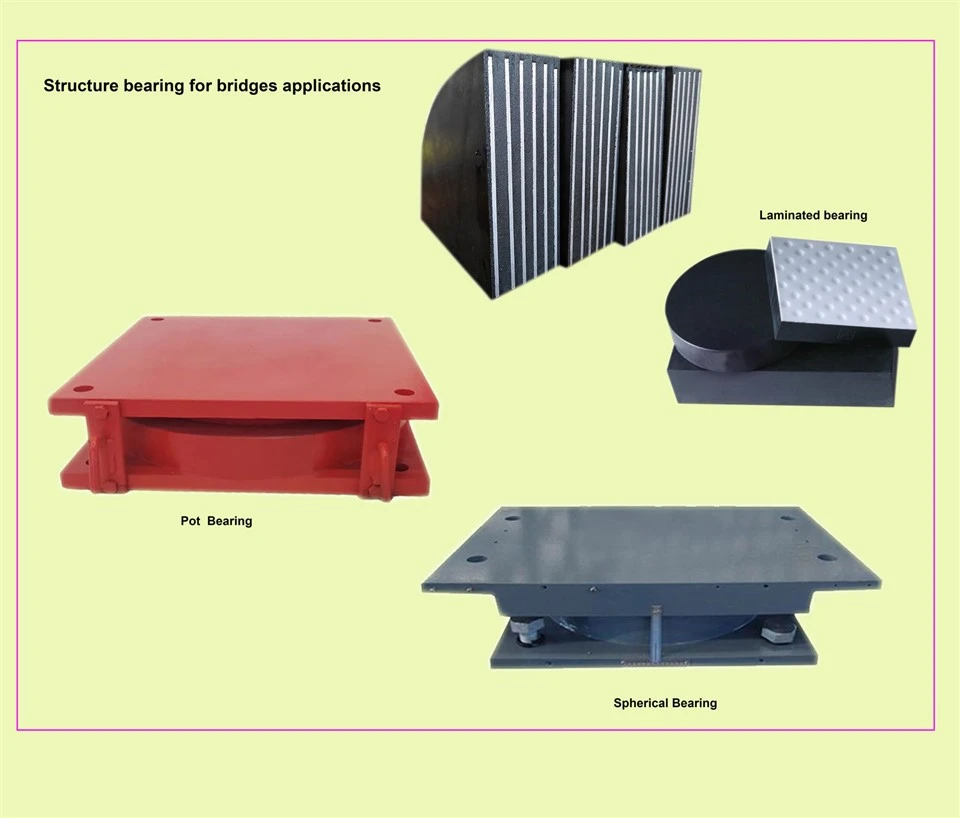


Bridge Bearing
Bridge bearings are indispensable structural components that serve as the critical connection between a bridge's superstructure (e.g., girders, decks) and substructure (e.g., piers, abutments). Their primary role is to efficiently transmit vertical and horizontal loads while accommodating controlled movements and rotations caused by external factors such as temperature fluctuations, concrete creep and shrinkage, dynamic traffic loads, and seismic activities.

Main Products


S
core Functions
More Than Just a "Simple Pad"!

Bearing Loads
Shouldering the Heavy Burden Like a Pro ♂️
The primary task of bridge bearings is to bear the full load of the bridge's superstructure, including the deck's dead weight, vehicle pressure, wind loads, and more, while safely transferring these forces to piers or abutments. Without them, the deck would press directly onto piers, leading to localized stress concentration that could cause concrete cracking or even collapse!
By the numbers: A single bearing for a medium-sized highway bridge can support over 500 tons, while high-speed railway bridge bearings must withstand the dynamic impact of high-speed trains!
Adapting to Deformations
Dancing with Thermal Expansion and Contraction 💃
Steel and concrete expand with heat and contract with cold. Bearings must allow the beam to expand and contract freely-otherwise, the bridge structure will crack due to stress from deformation. For example, elastomeric bearings absorb displacement through the shear deformation of rubber layers, while spherical bearings enable multi-directional rotation.
Cases in point: The bearings of the Hong Kong-Zhuhai-Macao Bridge are designed to adapt to a temperature range of -30℃ to 60℃, with expansion and contraction capacity reaching tens of centimeters!
.


Seismic Isolation and Energy Dissipation
Remarkably Stable During Earthquakes 🐕
During earthquakes or strong winds, bearings reduce structural damage by dissipating vibration energy. For instance, lead rubber bearings absorb seismic energy through the plastic deformation of lead cores, while friction pendulum bearings dissipate impact force via sliding friction.
Cutting-edge tech: Luzetech seismic bearings can even allow bridges to move horizontally by 1 meter during earthquakes without collapsing!
Adjusting Height
The Savior for Construction Errors!
Since precision turning machines operate autonmously and without any manual intervention, they bypass the possibility of human errors seeping into the manufacturing process, leading ro defects. With codes and software programs governing the end-to-end process, the machines can deliver greater accuracy without any flaws.

How to Choose the Right Type of Bridge Bearings?
- Elastomeric Bearings: The preferred choice for medium and small-span bridges, cost-effective and durable.
- Pot Bearings: Suitable for long-span bridges with higher load-bearing capacity.
- Spherical Bearings: Ideal for curved or skew bridges, featuring flexible multi-directional rotation.


Hot Tags: bridge bearing, China bridge bearing manufacturers, suppliers, Elastic Sliding Bearings, seismic isolation cobalt, seismic isolation alloys, seismic isolation hafnium, seismic isolation bromine, seismic isolation titaniums


