


Velocity Lock-up Device (LUD) & Velocity Lock-up Bearing (VLB) for bridges
Velocity Lock-up Device (LUD/LUD) and Velocity Lock-up Bearing (VLB) are innovative passive seismic protection products developed by Luzetech, specialized for bridges and large-scale construction projects in seismic zones, high-wind regions, or scenarios with significant vehicle braking forces.

1. Product Overview
Velocity Lock-up Device (LUD/LUD) and Velocity Lock-up Bearing (VLB) are innovative passive seismic protection products developed by Luzetech, specialized for bridges and large-scale construction projects in seismic zones, high-wind regions, or scenarios with significant vehicle braking forces.
Lock-up Device or Shock Transmission Unit(STU) is an oil cylinder-type anti-seismic equipment primarily applied in bridges and large-scale buildings to resist sudden impact loads such as earthquakes and emergency braking. Its core function lies in coordinating structural forces through a dynamic locking mechanism: it allows bridges to expand and contract freely under daily conditions, while rapidly locking piers and bridge decks during sudden vibrations, enabling multiple piers to jointly share longitudinal loads. The device is filled with a high-viscosity silicone resin medium featuring reverse thixotropy-flowing slowly to adapt to minor displacements under normal conditions, and its viscosity surges to render the fluid nearly solidified upon high-speed impact, achieving instantaneous piston locking. The main body is constructed from high-strength corrosion-resistant stainless steel and alloy steel, with a sealing structure optimized for the characteristics of silicone resin. Its service life is limited by the aging of sealing components and material corrosion. During installation, it is crucial to ensure that the axis aligns with the direction of bridge deformation, and adjustment devices should be configured to accommodate installation errors-for instance, length adjustment can be achieved through frames, vacuum cylinders, and pin-hole connection mechanisms.
Velocity Lock-up Bearing is a new type of seismic bearing ingeniously combining LUD with standard movable bearings (pot rubber bearings or spherical steel bearings). It is suitable for bridges and other large-scale construction projects in seismic zones, as well as environments with strong winds and significant vehicle braking forces. VLB effectively bears vertical and horizontal loads; its standout feature is that LUD locks under earthquake or braking forces, restricting relative movement between the upper and lower parts of the bearing, and enabling both movable and fixed piers to share horizontal forces jointly. VLB reduces project costs, offers excellent durability, and facilitates convenient installation, inspection, and replacement.

2. Working Principle

Both products operate based on speed-triggered state switching, with silicone as the damping medium and core components including end caps, silicone oil, cylinder barrels, and sealing systems:
Normal Conditions: Creep or temperature changes of the girder drive slow relative movement between the girder and pier cap, causing the piston to move slowly within the cylinder. Silicone flows gradually from one chamber separated by the piston to the other, resulting in minimal reaction force on the piston rod.
Seismic/Braking Conditions: When the relative movement speed of the piston against the cylinder exceeds LUD's design speed, silicone cannot flow between chambers promptly or moves extremely slowly. At this point, piston movement stops or slows significantly, triggering LUD to lock, and the reaction force on the piston rod exceeds the design horizontal load. Unlike conventional fluid dampers, LUD does not prioritize energy dissipation and shock absorption; its primary function is force distribution and transmission. During earthquakes or strong winds, LUD or VLB locks and acts as a rigid connection, ensuring horizontal forces are evenly distributed across multiple piers to achieve seismic protection effects.
3. Technical Specifications
3.1 Core Performance Parameters
|
Parameter |
Specification |
|
Vertical Bearing Capacity |
16 grades: 10000, 12500, 15000, 17500, 20000, 22500, 25000, 27500, 30000, 32500, 35000, 37500, 40000, 45000, 50000, 60000 kN (customizable for requirements exceeding standard specifications) |
|
Design Rotation Angle |
0.02 rad |
|
Operating Temperature Range |
-40°C ~ +60°C |
|
Design Horizontal Force & Locking Force |
- Longitudinal VLB: Transverse design horizontal force = 10% of vertical bearing capacity; Longitudinal design locking force = 10% of vertical bearing capacity <br> - Multi-directional VLB: Transverse design horizontal force = 5% of vertical bearing capacity; Longitudinal design locking force = 10% of vertical bearing capacity <br> (Customizable for special requirements) |
|
Design Displacement |
- Longitudinal/Multi-directional VLB: ±100mm, ±150mm (longitudinal direction) <br> - Multi-directional VLB: ±10mm (transverse direction) <br> (Customizable for displacements exceeding standard specifications) |
|
Locking Trigger Condition |
When the relative speed V between the bridge and pier ≥ 1 mm/s, the locking force F ≥ design locking force |
3.2 Product Selection Guidelines
Choose VLB if the locking force F ≤ 4000 kN or installation space is limited.
Choose LUD if 4000 kN < F ≤ 20000 kN and installation space is sufficient.
4. Testing equipment

5. Product Testing

This product have passed rigorous testing at Shanghai Tongji Construction Engineering Quality Inspection Station, including:
5.1,Slow Speed Test:
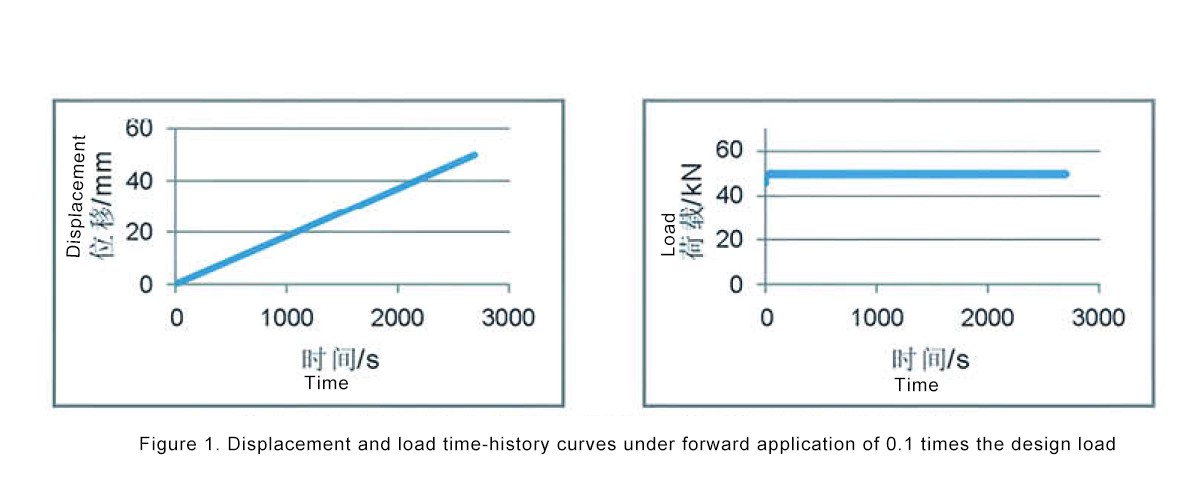
Apply 0.1 times the design load for 2694s: the Velocity Lock-up Device (LUD) displaces 50.003mm at a speed of 0.01856mm/s, which meets the inspection requirement of being greater than 0.01mm/s.

Then apply 0.1 times the design load in the reverse direction for 5245s: the LUD displaces 101.2116mm at a speed of 0.019296mm/s, which meets the inspection requirement of being greater than 0.01mm/s.

Then apply 0.1 times the design load in the reverse direction again for 3311s: the LUD displaces 53.4333mm at a speed of 0.016138mm/s, which meets the inspection requirement of being greater than 0.01mm/s.
5.2, Impact Test: 
From 0 to the design force F, the product displaces 5.4017mm; during the 5s holding period, the displacement is 2.7465mm; the displacement from F to -F does not exceed 13.2904mm. All meet the inspection requirements.
No leakage, bending, or damage occurred to the product during the test.
5.3, Overload Test:

Apply 1.5 times the design load (1.5F) within less than 0.5s and hold for 5s; then immediately apply 1.5 times the design load in the reverse direction within 1s and hold for another 5s.
No leakage, bending, or damage occurred to the product.
5.4, Cyclic Load Test:

Apply 5 sinusoidal force cycles at a loading frequency of 0.5Hz. When the load reaches the design load F, the displacement is 4.9744mm; when the load changes from F to -F, the displacement is 13.031mm.
No leakage, bending, or damage occurred to the product in testing.
6. Key Differences from Viscous Fluid Damper (VFD)
|
Aspect |
Velocity Lock-up Device (LUD)/Velocity Lock-up Bearing (VLB) |
Viscous Fluid Damper (VFD) |
|
Core Function |
Force distribution and transmission via speed-triggered locking |
Energy dissipation and shock absorption via fluid throttling |
|
Working Mechanism |
Dual-state switching: Free movement at low speed; rigid locking at high speed |
Continuous damping force proportional to movement speed (F=Cv^α) |
|
Energy Characteristic |
Minimal energy dissipation; acts as a rigid connection when locked |
Active energy dissipation (efficiency: 40%–60%) with non-linear hysteretic loops |
|
Application Focus |
Seismic force redistribution and load balancing for non-floating bridge systems |
Vibration control for floating bridges, high-rise buildings, and industrial equipment |
|
Structural Design |
Integrated locking trigger mechanism; dual-chamber structure with silicone as the medium |
Simple single-chamber structure with damping orifices; filled with viscous fluids (e.g., silicone oil) |
|
Maintenance Requirement |
Regular inspection of trigger mechanism reliability and sealing system integrity |
Routine checks for medium leakage; no trigger mechanism maintenance needed |
7. Application Scenarios

Bridges: Continuous beam bridges, simply supported beam bridges, and non-floating bridge systems requiring balanced deformation adaptation and seismic resistance.
Large-Scale Buildings: Structures in seismic zones or high-wind areas that need horizontal load redistribution.
Special Projects: Infrastructure subject to significant braking forces or temperature-induced displacements.

Hot Tags: velocity lock-up device (lud) & velocity lock-up bearing (vlb) for bridges, China velocity lock-up device (lud) & velocity lock-up bearing (vlb) for bridges manufacturers, suppliers


