


High-Load Multi-Rotational (HLMR) Bearings under AASHTO LRFD Section 14
High-Load Multi-Rotational (HLMR) bearings represent one of the most important bearing families defined in AASHTO LRFD Bridge Design Specifications, Section 14: Joints and Bearings. Engineered to carry massive vertical and horizontal loads while enabling smooth multi-axial rotation, HLMR bearings are the first choice for large-span, curved, skew and complex highway bridges across North America. If you are a bridge engineer, DOT reviewer or procurement specialist, understanding HLMR classification, limit-state rules and compliance pathways is essential for reliable, code-aligned bridge design.
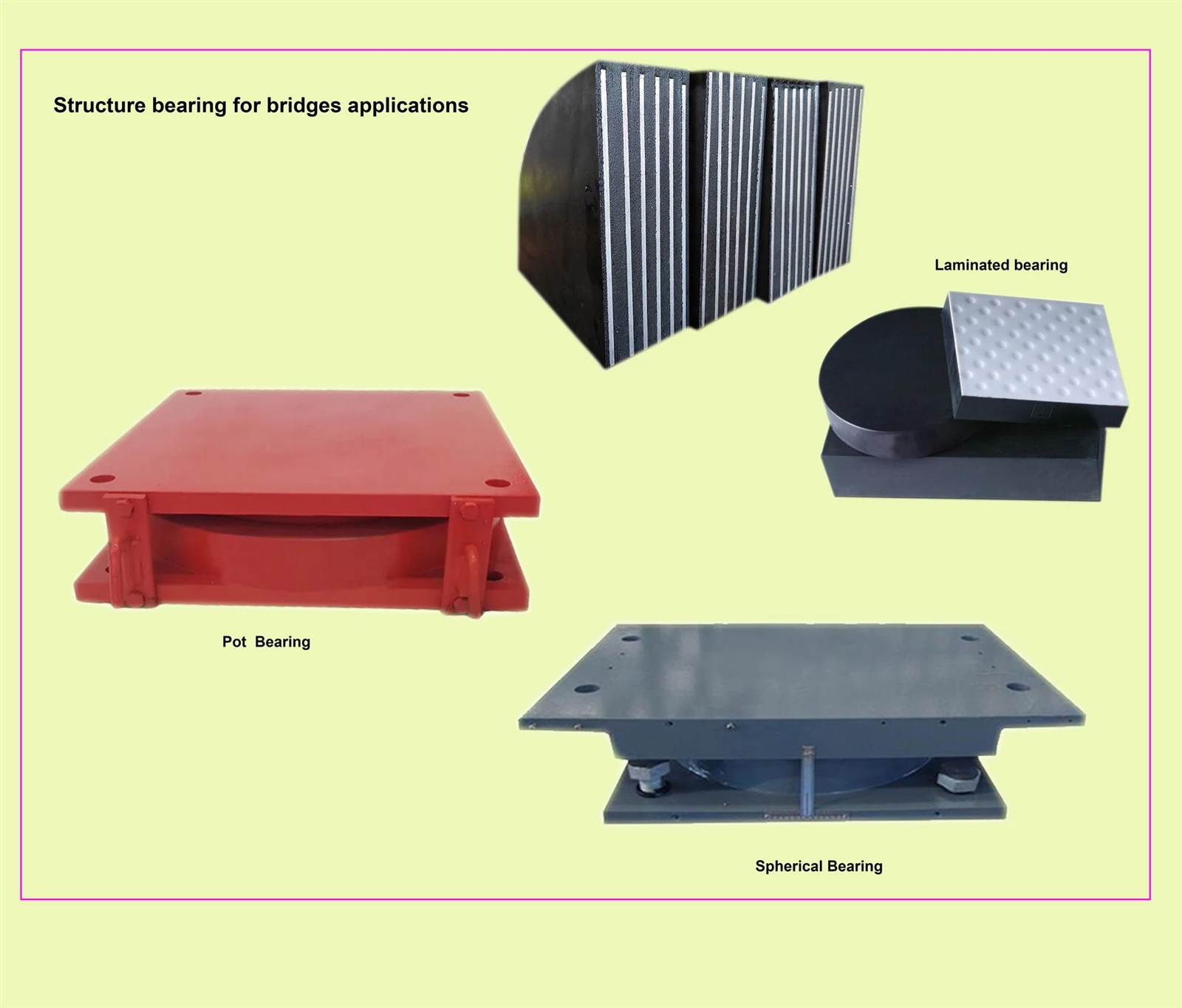
Three primary bearing types fall under the HLMR umbrella: pot bearings, disc bearings, and spherical bearings. Each achieves multi-directional rotation through a different mechanism. Pot bearings rely on a confined elastomeric pad sealed inside a steel pot; disc bearings use a solid polyurethane disc to accommodate rotation; spherical bearings depend on matched convex and concave steel sliding pairs with PTFE and polished stainless steel contact surfaces, free from long-term rubber aging concerns. All three can be manufactured as fixed, guided unidirectional or free multi-directional expansion units, to match the required restraint and movement scheme of the superstructure.
AASHTO LRFD governs HLMR bearings through the standard three-limit-state framework: service limit state, strength limit state, and extreme event limit state. At the service limit state, designers control long-term durability, sliding interface pressure, friction and rotational margins. Mandatory additional rotation allowance includes an uncertainty rotation of 0.005 rad plus 0.005 rad for construction tolerance, and total rotation must be calculated by vector superposition rather than simple algebraic summation. For PTFE-stainless sliding interfaces, the commonly adopted dry friction coefficient is 0.03, with upward adjustment for low temperature, contamination and ageing risks.
The strength limit state verifies the load capacity of all primary steel components, including bearing plates, pot walls, guide blocks, ball crowns and anchor bolts, following LRFD load and resistance factor principles. Under the extreme event limit state, especially seismic loading, HLMR bearings and their restraint hardware must avoid brittle collapse, often with supplementary checks against the AASHTO LRFD Seismic Guide Specifications.
It is worth noting that AASHTO LRFD provides comprehensive design articles for pot bearings, while offering general performance principles rather than full detailed formulas for spherical and disc HLMR bearings. For practical design, fabrication, prototype testing and quality control, engineers combine the AASHTO base requirements with widely accepted supplementary standards. Spherical HLMR bearings routinely follow ASTM D5977, the dedicated standard for high-load rotational spherical bearings. Many state DOTs also publish local memoranda; Caltrans Memo to Designers 7-1 is among the most frequently referenced documents for spherical bearing stress and geometric control. A well-known project rule for restrained HLMR spherical bearings limits the ratio of maximum horizontal force to minimum vertical service load to 0.40, a common check item during DOT technical review.
Selecting the right HLMR bearing depends on project constraints. Pot bearings deliver proven performance with moderate rotation demand but rely on sealed elastomer. Disc bearings offer compact layout and stable rotational behaviour and remain popular for steel girder bridges. Spherical HLMR bearings stand out when large rotation, low maintenance and resistance to rubber degradation are priorities, performing reliably even in cold regions and under repeated cyclic displacement.
All HLMR bearings must accommodate the full spectrum of structural movements: thermal expansion and contraction, concrete shrinkage, creep, prestress shortening, live-load deflection and seismic drift. Fixed HLMR bearings resist horizontal forces while allowing rotation; guided bearings permit movement along one axis and restrain transverse drift; free-sliding HLMR bearings release horizontal forces completely to reduce stress in the superstructure and substructure.
For international manufacturers bidding on US highway projects, HLMR compliance is more than matching geometry and load capacity. Submittals must clearly demonstrate alignment with AASHTO LRFD Section 14, supporting standards, state special provisions and required prototype testing. Our HLMR bearing range, including AASHTO-compliant spherical bearings, is engineered and tested to satisfy these rigorous requirements for North American transportation infrastructure.
In summary, HLMR bearings form the backbone of heavy-load bridge support systems under AASHTO LRFD. With careful type selection, strict limit-state verification and properly referenced supplementary specifications, these bearings deliver decades of safe, predictable performance for modern highway bridges.
