


"Sail of Ice", National Gymnasium.
The National Gymnasium is located in the southern part of the central area of Beijing Olympic Park, adjacent to the "Bird's Nest" and the "Water Cube". It was once one of the three main venues of the 2008 Beijing Summer Olympics and is also the largest indoor comprehensive gymnasium in Asia. The total construction area of the venue is approximately 80,000 square meters. The main hall can accommodate 20,000 spectators, and the auxiliary hall can accommodate 1,800 spectators. During the 2008 Summer Olympics, it hosted gymnastics, trampoline, handball competitions, as well as wheelchair basketball competitions in the Paralympic Games. A total of 14 gold medals were decided here, among which the Chinese team won 11 gold medals. It is the venue where Chinese athletes won the most gold medals, and thus has gained the reputation of a "lucky place" and a "golden nest".
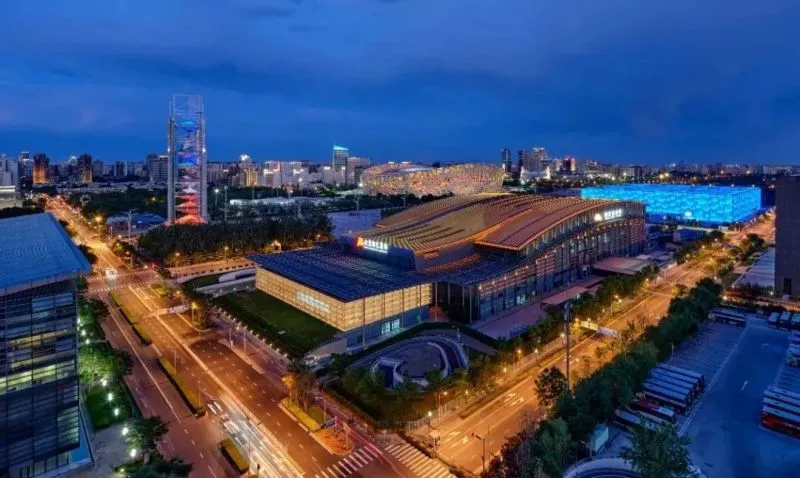
As a competition venue for the 2022 Winter Olympics and Paralympics, the National Gymnasium launched a comprehensive renovation as early as 2019. According to the plan, the main venue and the auxiliary venue are renovated buildings, and the training hall on its north side is an expanded building. After the renovation, the total area of the venue is approximately 98,000 square meters. On October 27, 2021, the National Gymnasium was happily given a nickname - the "Ice Sailing", which perfectly integrates with the "Ice Cube", the "Ice Ribbon" and others in the Olympic Park. This "Summer Olympics" venue has successfully transformed into the ice hockey venue for the Beijing Winter Olympics, achieving the "amphibious" ability to operate both winter and summer sports events, and has become a "double-Olympic venue". At the same time, it has also formed a brand-new architectural pattern jointly composed of the main hall, the auxiliary hall and the "Ice Castle" of the training hall.
The inspiration for the "Ice Sailing" comes from:
1. In terms of appearance, when looking at the National Gymnasium from the Olympic Tower, it is like a giant sailing ship sailing steadily on the lake in the central area of the Olympic Park.
2. In terms of the name, the Chinese character "帆 (fān)" in "冰之帆 (Bīng zhī Fān)" echoes the English nickname ICE FAN of the National Gymnasium in terms of homophony.
3. In terms of positioning, the National Gymnasium experienced the Summer Olympics in 2008, and 14 years later, it sets sail again, shouldering the historical mission of hosting the ice hockey events of the Beijing Winter Olympics. As a witness and participant of the development of the motherland, the National Gymnasium carries hopes and sustenance, sails steadily and far, and sets sail with its sails unfurled!

In order to improve the seismic performance of the newly built training hall and reduce the temperature effect of the extra-long and large-span structure, the design team installed friction pendulum bearings(FPB) at the tops of 16 reinforced columns and added a set of eddy current dampers on the sides, forming a large-span and heavy-load horizontal isolation system composed of friction pendulum isolation system(FPS) and eddy current dampers, which greatly increases the overall shock absorption effect. In the face of vibrations, the 1,500-ton roof can have a free displacement of 15 cm within a 360-degree range and can withstand the test of an earthquake of magnitude 8.

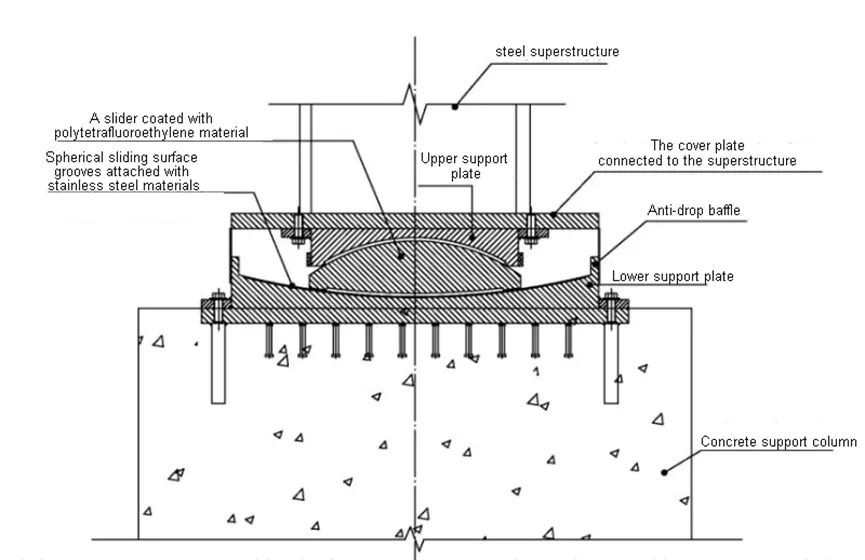
A friction pendulum isolation system is a seismic isolation technology commonly used in building structures. It mainly consists of friction pendulum bearings, which are installed in base isolation layer or between the building's foundation and superstructure or at other key positions. Here is a detailed introduction:
1, Composition and Structure: A typical friction pendulum bearing includes a base plate, a curved sliding surface, and a slider. The curved sliding surface is usually in the shape of a spherical or cylindrical arc, and the slider can move on this surface.
2, Working Principle: As mentioned before, when an earthquake occurs, the slider on the friction pendulum bearing will slide and swing on the curved surface. This swinging mechanism prolongs the natural vibration period of the structure, moving it away from the dominant period of the earthquake ground motion, thereby reducing the seismic force acting on the structure. Meanwhile, the friction between the slider and the curved surface dissipates energy, converting the seismic energy into heat. After the earthquake, the slider can automatically reset to its initial position under the action of gravity due to the shape of the curved surface.
3, Advantages: It has good seismic isolation performance, which can effectively reduce the seismic response of the structure and protect the building and its internal facilities from earthquake damage. It also has strong adaptability to different earthquake intensities and frequencies. In addition, the friction pendulum isolation system has good durability and reliability, and requires relatively low maintenance.
4, Applications: This system is widely used in various important buildings, such as hospitals, schools, high - rise buildings, bridges, and some public service facilities. For example, some newly built hospitals in seismic - prone areas often adopt the friction pendulum isolation system to ensure the safety of medical facilities and the continuity of medical services during an earthquake.

1, Origin of the concept: The idea of seismic isolation dates back to the late 19th and early 20th centuries. In 1881, Kawaichi Kozo proposed the concept of base isolation. In 1909, a British doctor named Calantarients proposed an isolation technique that used a talc or mica layer between the foundation and the superstructure to protect buildings from earthquakes. However, due to technological limitations at that time, these concepts could not be effectively implemented.
2, Formation of the modern FPS: In the late 1980s, with the development of materials science and engineering technology, the modern friction pendulum isolation system emerged. The FPS was developed based on Coulomb's friction theory, which states that the friction coefficient is independent of the bearing pressure. The FPS uses a curved sliding surface to create a pendulum - like motion, which prolongs the natural vibration period of the structure and dissipates seismic energy through friction.
3, Development and improvement: After its invention, the FPS underwent continuous development and improvement. In the 1990s, the application of FPS in the construction industry gradually increased. Engineers optimized the design of the FPS, improved the performance of low - friction materials, and studied the effects of heating, contact pressure, and velocity on the system. Subsequently, double - concave friction pendulum and triple - friction pendulum bearings were developed to meet different engineering requirements.
4, Widespread application: In recent years, with the deepening of understanding of seismic isolation technology, the FPS has been widely used in various important buildings and infrastructure projects around the world, such as hospitals, schools, high - rise buildings, and bridges. In China, the FPS has also been gradually promoted and applied since the 2008 Wenchuan earthquake. In 2015, the China Academy of Building Standards applied for the establishment of the national standard Building Friction Pendulum Isolation Bearings, which introduced this new type of isolation bearing product widely used in European and American countries into the building field, filling the domestic technical gap. In 2019, the China Academy of Building Standards and its team successfully developed a low - friction - coefficient coating material, and the building - use friction pendulum isolation bearing came into being.

In summary, the friction pendulum isolation system has developed from the initial concept to the modern mature technology through continuous research and practice, and has become one of the important seismic isolation technologies.
REFERENCE FROM: 中国混凝土与水泥制品协会(CCPA).https://www.ccpa.com.cn/site/content/8534.html
