


AASHTO LRFD Spherical Bearings: Design, Classification and Core Specifications
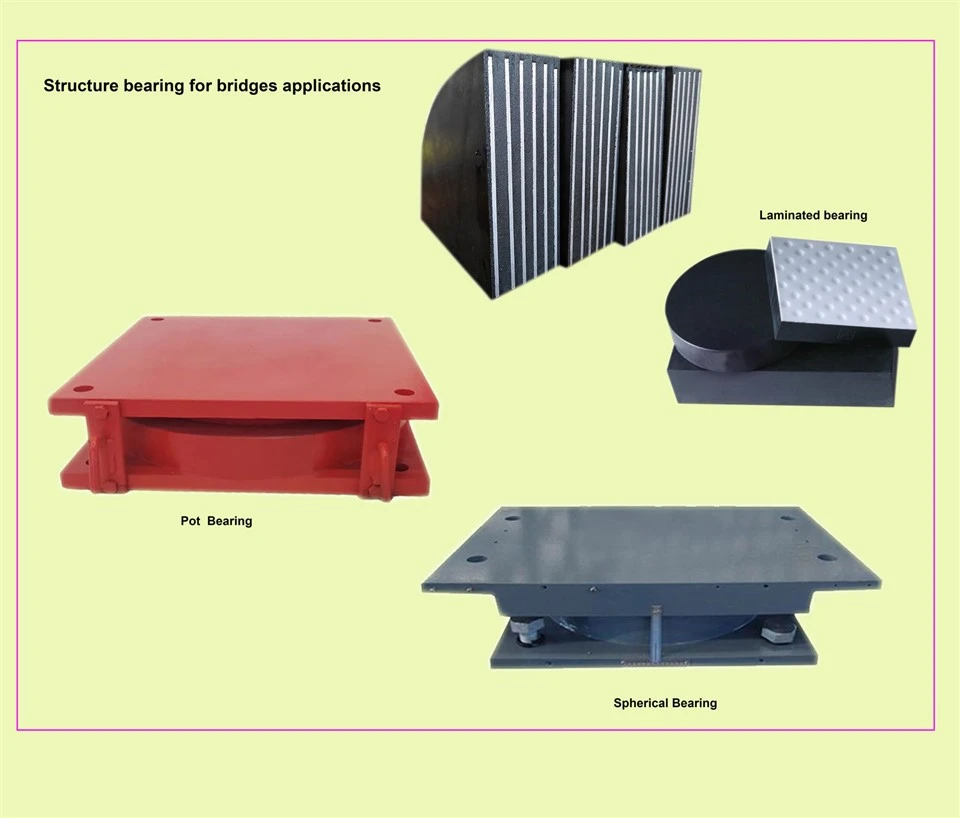
Spherical bearings are critical High-Load Multi-Rotational (HLMR) structural components widely adopted in modern highway bridge design. Governed by AASHTO LRFD Bridge Design Specifications Section 14, these bearings are engineered to transfer vertical and horizontal structural loads while accommodating multi-directional rotation and thermal displacement, making them the preferred solution for curved, skew, and large-span bridges in North American infrastructure projects.
Unlike conventional pot bearings or disc bearings restricted by limited rotational capacity, AASHTO-compliant spherical bearings feature a matched interface of convex and concave steel plates, paired with low-friction PTFE and stainless steel sliding surfaces. This structural configuration eliminates aging risks of rubber materials, delivers stable long-term performance, and meets the stringent durability and load-resistance requirements of AASHTO LRFD design standards.
AASHTO LRFD Classification of Spherical Bearings
Based on displacement and restraint functions, AASHTO LRFD divides spherical bearings into three standard types for differentiated bridge design scenarios, covering all common structural deformation demands:
Fixed Spherical Bearings: Designed to allow full multi-axial rotation while restricting all horizontal movements. These bearings undertake vertical loads and all-direction horizontal forces, serving as the fixed support point of the bridge superstructure and stabilizing the overall structural displacement system.
Guided / Unidirectional Sliding Spherical Bearings: Equipped with guide blocks to limit transverse displacement, these bearings permit free longitudinal sliding and omnidirectional rotation. They balance structural telescopic deformation and lateral stability, ideal for straight and regular curved highway bridges.
Free / Bidirectional Sliding Spherical Bearings: Offering unlimited multi-directional horizontal displacement and full rotational freedom, these bearings barely resist horizontal forces. They effectively release structural stress caused by temperature variation, concrete shrinkage, and creep deformation.
Core AASHTO LRFD Design Requirements
AASHTO LRFD adopts a three limit state design framework for spherical bearings, covering service, strength, and extreme event limit states to ensure comprehensive structural safety throughout the service life.
In the service limit state, design focuses on long-term durability and normal operational performance. The PTFE-stainless steel sliding interface is strictly controlled for stable compressive stress and friction coefficient. The standard dry friction coefficient is specified as 0.03, which shall be adjusted for low-temperature, polluted, or aging working conditions. Meanwhile, all spherical bearings must reserve additional rotation tolerance, including a mandatory 0.005 rad uncertainty rotation plus 0.005 rad construction tolerance, with total rotation calculated by vector superposition rather than simple algebraic addition.
The strength limit state verifies the structural safety of steel plates, ball crowns, guide blocks, and anchor bolts under design loads. All load-bearing components must meet LRFD load and resistance factor criteria to avoid structural damage under conventional extreme working conditions.
For the extreme event limit state, especially seismic conditions, spherical bearings are designed with enhanced toughness and stability. Combined with the AASHTO LRFD Seismic Guide Specifications, bearing restraint components are optimized to prevent brittle failure and ensure structural integrity during earthquakes.
Key Design Criteria & Supplementary Standards
A core practical rule widely recognized in AASHTO-based projects is the horizontal-vertical load ratio control: for restrained spherical bearings (fixed and guided types), the ratio of maximum horizontal force to minimum vertical service load shall not exceed 0.40. This criterion prevents local overpressure, PTFE tearing, and eccentric stress concentration on the spherical sliding interface, which is a key review point for North American DOT authorities.
While AASHTO LRFD provides universal design principles for HLMR bearings, it does not cover detailed spherical interface calculation and manufacturing specifications. In actual engineering and bidding practices, ASTM D5977 serves as the essential supplementary standard for spherical bearing fabrication, performance testing, and quality inspection, forming a complete AASHTO-compliant design and manufacturing system.
Advantages of AASHTO-Compliant Spherical Bearings
AASHTO LRFD spherical bearings stand out in highway bridge engineering for their superior performance. The all-steel main structure avoids rubber aging and fatigue failure, ensuring excellent durability and low maintenance costs. The full-range multi-axial rotation capacity adapts to complex bridge geometries, including ultra-curved, skew, and high-deflection bridges. In addition, the bearings maintain stable performance in low-temperature environments, making them suitable for diverse climatic conditions across North America.
Conclusion
As standardized HLMR bearing solutions under AASHTO LRFD Section 14, spherical bearings provide reliable load transfer and deformation adaptation for modern highway bridges. With clear classification criteria, rigorous three-limit-state design requirements, and complementary ASTM D5977 manufacturing standards, they have become the mainstream choice for high-standard North American bridge projects, balancing structural safety, long-term durability, and engineering applicability.
